Building equity value
If you are just starting your company, the idea of equity value is probably not on your radar screen. If you have owned you company for 10+ years, it has probably occurred to you that you might want to sell your company so you can do some world travel and work on that golf game. And if you are thinking about this now, you probably wish that you had started this thought process a long time ago.
There are many reasons to consider selling some or all of your interest in your company. In fact most of the real good reasons are not about cashing out and retiring – thought that’s not a bad concept. You may also need to think about your equity value because you are considering bringing on a partner that you want to be a shareholder. Or you may be thinking about buying another company. Or you may just be thinking about taking out a loan and you want to get bank financing. A key piece of all of these scenarios is knowing the equity value of your company because that is your ultimate bargaining chip. It is what you will trade or sell or use as collateral. If you have a low value, you won’t have much to bargain with. If you have a high value, you can get a lot and give up very little. We will discuss more of the math of this concept in a future posting.
So what specific actions can you take to build equity value? Your balance sheet is the starting point, but usually not the biggest part of the story. The simplistic answer is to look at the equity total on the balance sheet and see the accumulative effect of capital investments and retained earnings. But in a service business, these are generally not be big numbers. The next thing is to look at the market value of your company – a price that an investor would pay for you business. Some investors simply look at gross revenues and others look at profits or “surplus cash.” From here there are various formulas applied to produce an approximated market value. This value can be used to set share price, negotiate a loan, or sell the company.
The important thing to know is that there are many things you can do to maximize the company’s market value. Here are 6 key actions that can make a big difference:
- Move your customers to fixed monthly fee contracts – a more predictable revenue stream has much greater value than one-time transactions. Recurring committed revenues are the key to a higher market valuation.
- Show a clear message on profitability. The key to showing profitability is to separate base pay from bonuses and incentives. The later will be viewed as part of your profit picture.
- Create a consistent pattern of revenue growth. While growth can be difficult to make happen on a highly predictable basis, the worst kind of growth is the extremely lumpy growth where it all happens in big chunks a couple of times per year. Instead of contributing to a corporate valuation, highly lumpy growth can actually be viewed as negative and disruptive and can create negative valuation.
- Keep your customer contracts current. This is an area that is often ignored until a problem arises. It is actually best for customer relations to keep agreements visible and current. Agreements should include an automatic renewal provision so that they don’t expire just because the base term of the agreement has expired. Customer agreements have a big influence on how a corporate valuation is calculated.
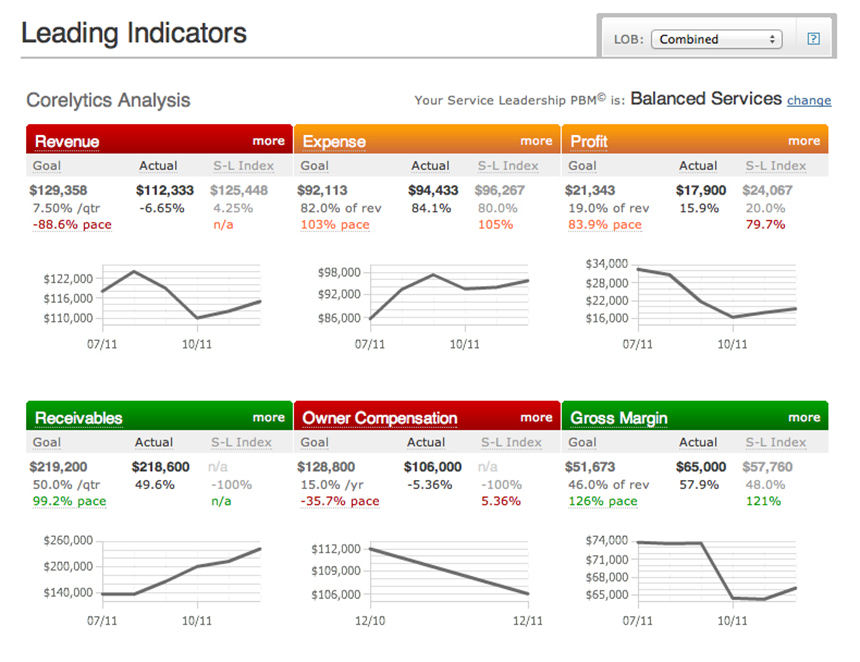
- Track direct and indirect costs and understand the trend lines in comparison to revenue. This may sound a little complicated, but this is often a very revealing piece of information. If overheads are growing just as fast as revenue, it signals that the company is not getting any benefit out of its growth – even worse if overhead is growing faster than revenue. Many other problems can surface from these comparisons. We will discuss more about these patterns in future with papers.
- Know how you compare to industry benchmarks. If your numbers are significantly different from industry standards, this is a strong signal of a fundamental business problem. Even having significantly greater profitability than industry norms can indicate that the business is not sustainable or not competitive. And this of course can have a negative impact on valuation.
These are a few of the major factors that influence a market valuation. Many other things go into a valuation, but if these are all tracking correctly, you are probably on your way to a solid business valuation. We haven’t discussed how you go about actually having someone establish a market-based valuation for your company – that is the topic of another paper. You can have this done by a number of sources that specialize in doing corporate valuations. And there are numerous way to make this work in your favor and not cost an arm and a leg. Stay tuned – more on this later.
—————————————–
CoreConnex provides the Corelytics(tm) Financial Dashboard and specializes in financial business intelligence tools for VARs, MSPs, channel distribution partners, IT service providers and other professional service companies. We encourage you to share experiences and perspectives as players in this professional community. This blog is moderated. Comments that are unprofessional or derogatory will not be posted.