Perspectives on Financial Planning for IT Service Companies

Asking an IT service company owner or senior manager to do financial planning is like asking a system user to become a technology expert. In worst case it’s like asking grandma to configure a network. Okay, that was extreme, but it makes a point. The problem is that a lot of the really important analysis and planning either doesn’t get done or it gets delegated to someone who is not in a position to do strategic thinking on behalf of the company.

 It is crucial that owners and managers make conscious decisions about what they want their business to accomplish. They need to set the goals and directions, communicate this to the rest of the team and then follow-up to be sure that everyone stays on track. With that in mind, here are some basic concepts about financial planning and management. As you read this, think about which of these processes are appropriate to delegate in your company.

 Business Accounting - or just “accounting” is the process of tracking data about money spent and money received and about amounts owed by you or by your customers to you. The accounting process is all about looking backward to see what has happened so that you can understand your current status. It looks back at revenues and expenses, figures out profitability and provides clues as to where spending may be out of line. This is also a required process to support tax filings. The accounting process is often all that some business owners ever do. They look backwards, update their records, and then figure out where they stand by reviewing financial statements. Of course they often are involved in billing, collecting, buying and selling, but none of this is about forward-thinking financial management. Business owners often spend too much time on accounting and not enough on the planning processes defined below.

 Financial Planning - sometimes referred to as forecasting or financial modeling, is all about projecting into the future. This is distinctly different from accounting. This is where you make assumptions about growth rates, needed investments, resource requirements, and business development processes. This is also where you set financial goals and make decisions about how you are going to achieve those goals. Many small business owners do not take this step or if they do it is done informally and with broad brush strokes. Forecasting and modeling are the first steps toward understanding the possibilities of your company and are key to planning (See also blog entry on Client Portfolio Analysis). If you hear a business owner say, “we don’t need any fancy analysis; all we need is more sales,” you know that this company is just lunging after opportunity and is not on a thought-out course.

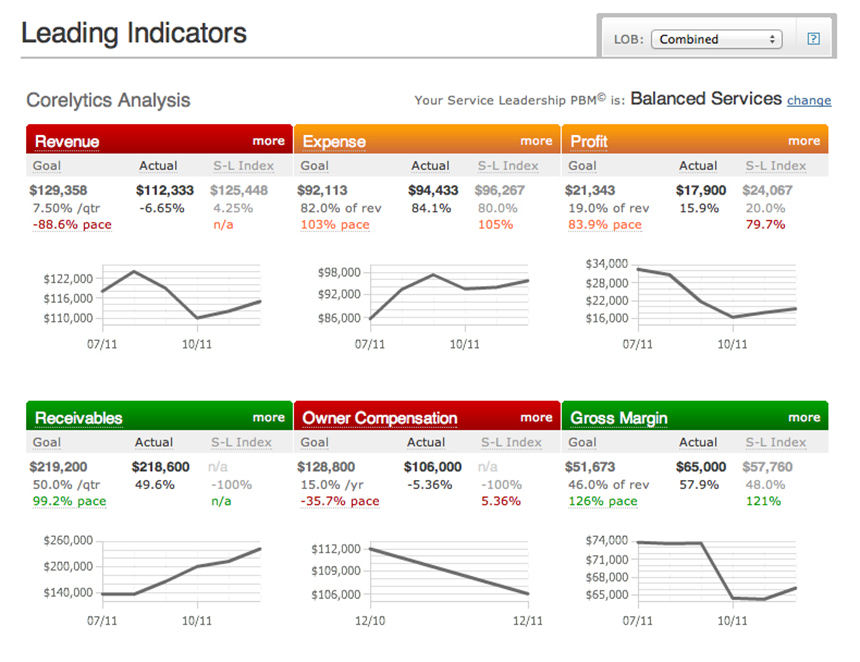
 Financial Management - this is the process of monitoring actual financial performance and comparing it to planned performance (discussed in the business planning process below). This is where you compare planned and actual budgets and then work with your organization to make adjustments to keep the company moving in the planned direction. If there is no comparison of planned to actual there can be no real meaningful performance corrections. And if you aren’t making course corrections, your business has no steering wheel. And a business without steering is not likely to achieve any long term goals - except by accident.

 Business Planning - a business plan ideally should be a short document. The best ones are only a few pages long. The plan should paint a summary level picture of where you are and where you are going and how you plan to get there.  It should be a combination of a financial plan and operating plan that achieve specific financial goals.  It needs to “connect the dots” in a way that anyone inside the company or outside the company can see exactly where you are trying to go and how you plan to get there - at a high level.

 Operations Planning - sometime just referred to as budgeting, is the bridge between the Business Plan and the day-to-day management process. This is the document that takes the business plan and turns it into a month-by-month, even a day-by-day execution plan expressed in numbers. In its most complete form it sets performance goals and tracks results for new sales, add-on sales, monthly recurring revenue, hours of billable work, customer satisfaction scores, staff utilization and other performance metrics that tie back to the business plan. Most companies do some form of operations planning and budgeting, but all too often with no connection to the business plan. When budgeting and performance plans are not tied to business goals it is likely that they are simply intended to make ends meet. The likely result is a no-growth business.

 Market Intelligence - sometime referred to as Business Intelligence (thank you Microsoft) and is all about adding awareness of what is happening in your market into your business planning process.  The right information can help you know if your business is performing better or worse than other similar businesses. Most market intelligence is anecdotal and not statistically based, so it s really hard to translate into goals, or budgets and performance metrics. But in the end, it is important to find a way to translate raw intelligence into meaningful numbers that can be incorporated into the planning and management process. The best market intelligence comes in the form of benchmarks that are specific to businesses just like yours (see bog entry entitled Getting Value From Business Benchmarks). Well defined benchmark information can take a lot of guess work out of planning and goal setting and help you work toward proven and realistic performance goals. Good benchmarking should be incorporated into Financial Planning, Business Planning and Operations Planning. Industry Benchmarks can provide a major advantage by eliminating unrealistic expectations and can be a great tool for communicating to staff that they are not being asked to do anything that is out of line for your industry.

These topics and more will be further explored in future entries. Your feedback on these business concepts is much appreciated.

Leave a Comment

Blog-Powered Website
By ContentRobot