Small Businesses are the Engine of the Global Economy
Small businesses generate more than 50% of the GDP and employ about 70% of the workforce (data from Wikipedia). Since the US GDP is about $14.5 trillion and the number 2 global economy is China at $5.9 trillion, you can see that the small business engine in the US is bigger than the GDP of China.
And small business is an even larger percentage of the global economy outside of the US. So while the media spotlight is generally on big business, it is small businesses that are doing the heavy lifting.
The challenges for small businesses are increasing at a pace faster than ever before. Not only is the global economic squeeze making it harder for small businesses to thrive, new pressures from technology and global communications are changing the way the world does business. The simple fact is, small business cannot stand still and expect to thrive.
Small businesses have the opportunity to play the new global pressures to their advantage. By adopting new technologies, they can do transactions faster than ever before, they can reach larger markets and they can find out what is important to their customers like never before.
To evolve, small business must really get to know their numbers and manage performance with precision. It used to be that it was okay to count up the money at the end of the month, decide which bills to pay and call it good. In the past decade most small businesses have deployed accounting software to better manage their business. This can give them a much better understanding of accounts receivable, accounts payable, and cash requirements forecasting. But that is no longer enough. It’s time for the next generation of business metrics management – we are calling it Business Management 3.0.
The new reality is that we can no longer look at business as a 2-dimensional exercise. It is not good enough to say how I am doing at a specific point in time. The bigger question is how am I doing over a period of time and where does that take me in the future? Rather than static numbers found in an Income Statement (a.k.a., Profit and Loss Statement) and a Balance Sheet, businesses need to look at dynamic numbers that show trend lines and forecasts which tell where a company is headed. The 2-dimension picture describes where the company is; the 3-dimensional picture describes where the company is going. This is Business Management 3.0.
In the past. the roadway for most small businesses meandered with a few minor bends in the road. Now the roadway has many more rapid twists and turns. The old school approach to management reporting simply cannot deal with the new dynamics.
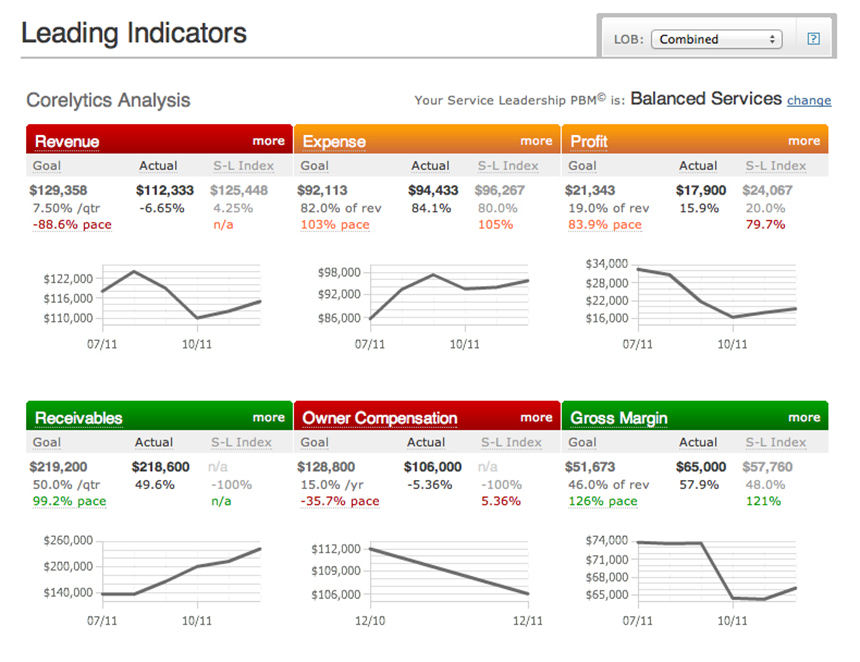
The new Business Management 3.0 approach to financial reporting requires a view of the entire picture, including internal data combined with external business intelligence. We will see the need for this kind of reporting increase in the months and years ahead. It will soon be expected that you have a graphical financial dashboard that incorporates business intelligence just like we are seeing GPS become a navigational necessity. Today dashboards are viewed as a competitive advantage; they allow high-precision decisions and get monthly visibility on how our results line up with our goals. In the future this will be considered a basic necessity for survival.
The perfect storm of economic pressures, new technologies and improved processes make this the time for small business to seize control and make an impact in our economy.
If each small business made a 5% improvement, we would improve our economy one full Chilean GDP. That’s what our dashboard sets out to do. It’s time for small business to take the lead and thrive!
Great insights Frank! Resonates with the saying well- Start Small – Think Big!Its amazing to see how much support in terms of resources these small business receives from the US government!Small business usually suffers from undercaptialization. So having a Financial Dashboard ( the Corelytics Dashboard) definitely will help them keep a track on their financial performance and see where there are in terms of the benchmarks and how they can grow from small to big!
It’s really hard to believe that 70% of the workforce is employed by small businesses while most people are eyeballing big companies, like GE and Wal-Mart, as the engine of the economy. It would be great to see small businesses using new technologies as part of their competitive advantage, but I think the most challenging thing is educating them the necessity of new technologies, because they always have very limited resources and maybe limited awareness. (My Mom is doing the accounting using the abacus for her small business, and she still thinks there’s no need to change…)
Great article Frank !!!! I probably had a different view about smaller businesses, the impact it has on employment and revenues it generates. This is great piece of information. I am sure more exposure to Financial Dashboard like the Corelytics Dashboard will give these small companies an additional advantage and leverage their position in market. So the whole economy will benefit from it.